Guitar Scales
Unlocking the Fretboard: The E Minor Pentatonic Scale (All 5 Shapes)
Ready to stop just strumming and start soloing? This is where it all begins.
If chords are the rhythm of a song, scales are the voice. And when it comes to playing lead guitar — rock, blues, or metal — one scale rules them all: the Minor Pentatonic Scale.
The word “pentatonic” literally translates to “five notes.” By using only five selected tones, this scale creates a sound that works beautifully over almost any chord progression.
And the best place to start? E Minor Pentatonic. It is the most natural key on the guitar — your open Low E and High E strings are already part of the scale. This is the foundation of legendary solos by Chuck Berry, Eric Clapton, Angus Young, Slash, and Gary Clark Jr.
The secret to playing all over the guitar neck isn't magic — it's just memorizing 5 interlocking puzzle pieces. Let's break them down.
The “Puzzle Pieces”: Understanding the 5 Shapes
The E Minor Pentatonic scale covers the entire guitar neck, but trying to memorize the whole neck at once is overwhelming. Instead, guitarists break the scale down into 5 “Boxes” or “Shapes.”
When you connect these shapes, you can slide from the open position all the way to the 12th fret without hitting a single wrong note.
Shape 1: The “Open Position Box” (Open to Fret 3)
If you only ever learn one scale shape in your life, make it this one. In the key of E, this shape incorporates open strings, giving you that raw, powerful sound heard on countless classic rock records.
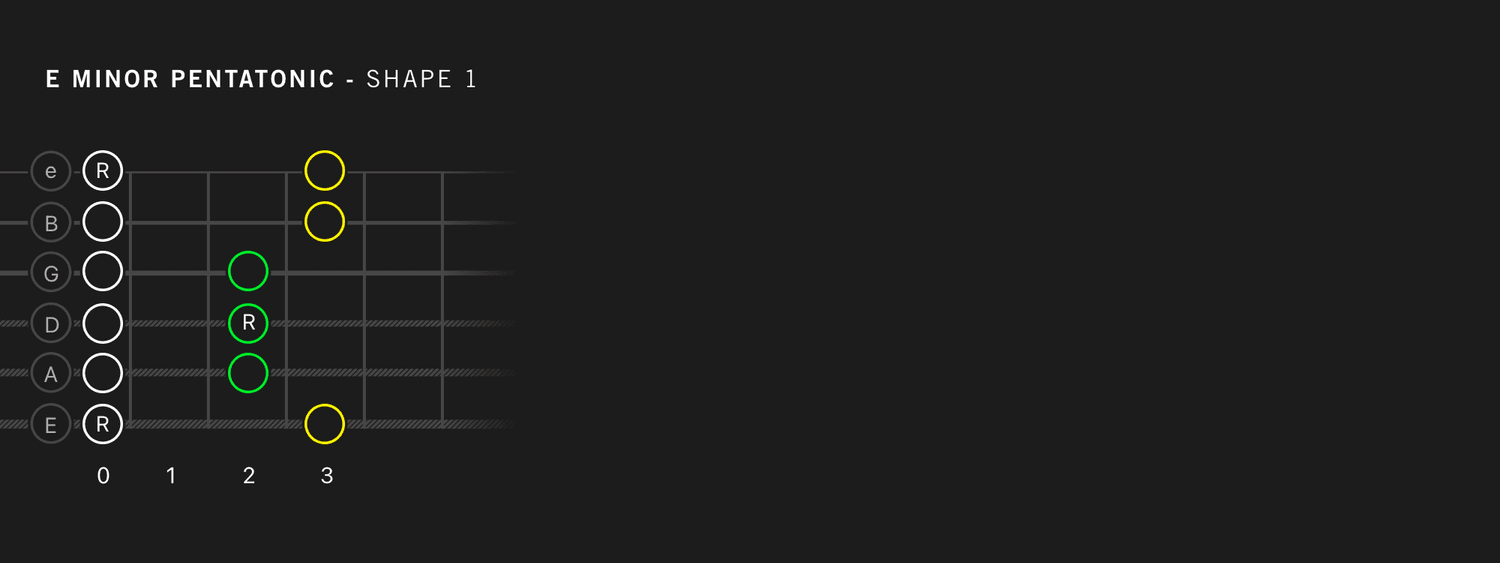
Where it lives: Starts with your open Low E string (that note is ‘E’, the root of the scale) and extends to the 3rd fret.
The pattern: You play two notes per string. On the outside strings (E and e), you use the open string and the 3rd fret. On the middle strings (A, D, G, B), you use the open string or 2nd fret and the 3rd fret.
Why it's great: The open strings let you play lightning-fast riffs with minimal left-hand effort. It's the go-to position for classic rock rhythm-and-lead playing.
Shape 2: The “Extension Box” (Frets 2 to 5)
Once you are comfortable in Shape 1, Shape 2 is your immediate next-door neighbor moving up the neck.
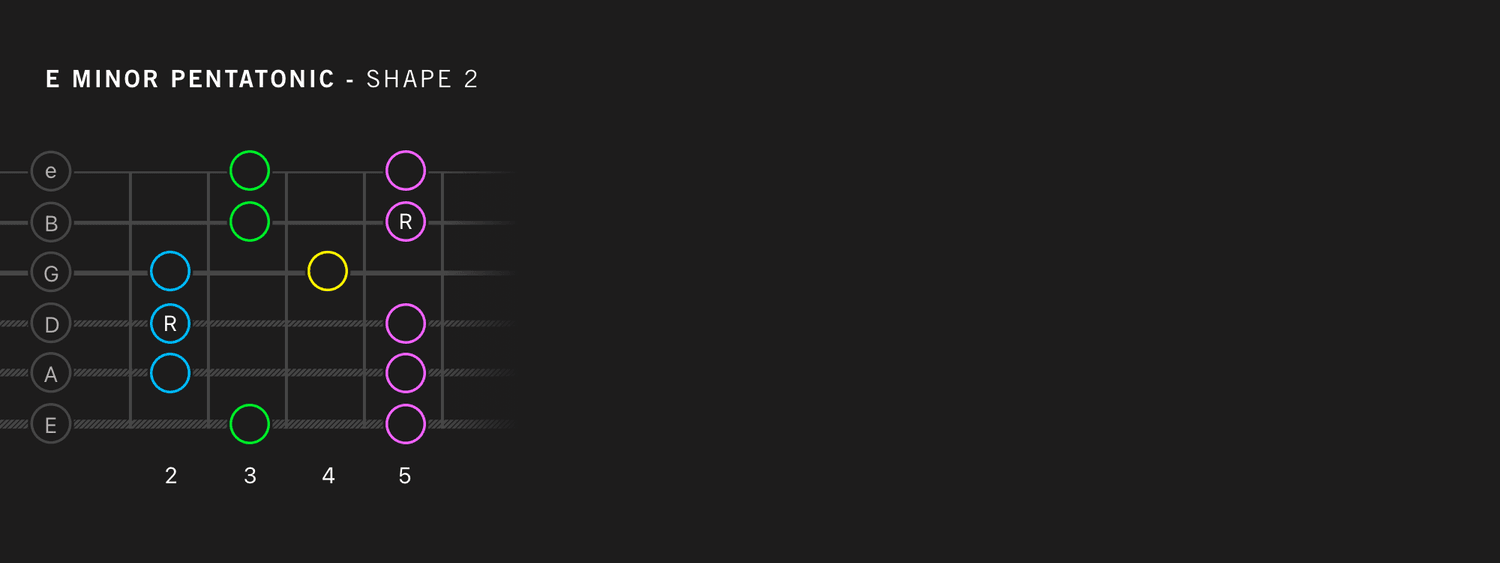
Where it lives: It shares notes with Shape 1, starting where Shape 1 ended. Your index finger takes over on the 2nd and 3rd frets.
Why it's great: This shape introduces a “diagonal” feel. It is perfect for sliding into notes from Shape 1 to add a smooth, vocal-like quality to your solos.
Shape 3: The “Middle Connector” (Frets 5 to 7)
This shape bridges the lower-middle part of the guitar neck.
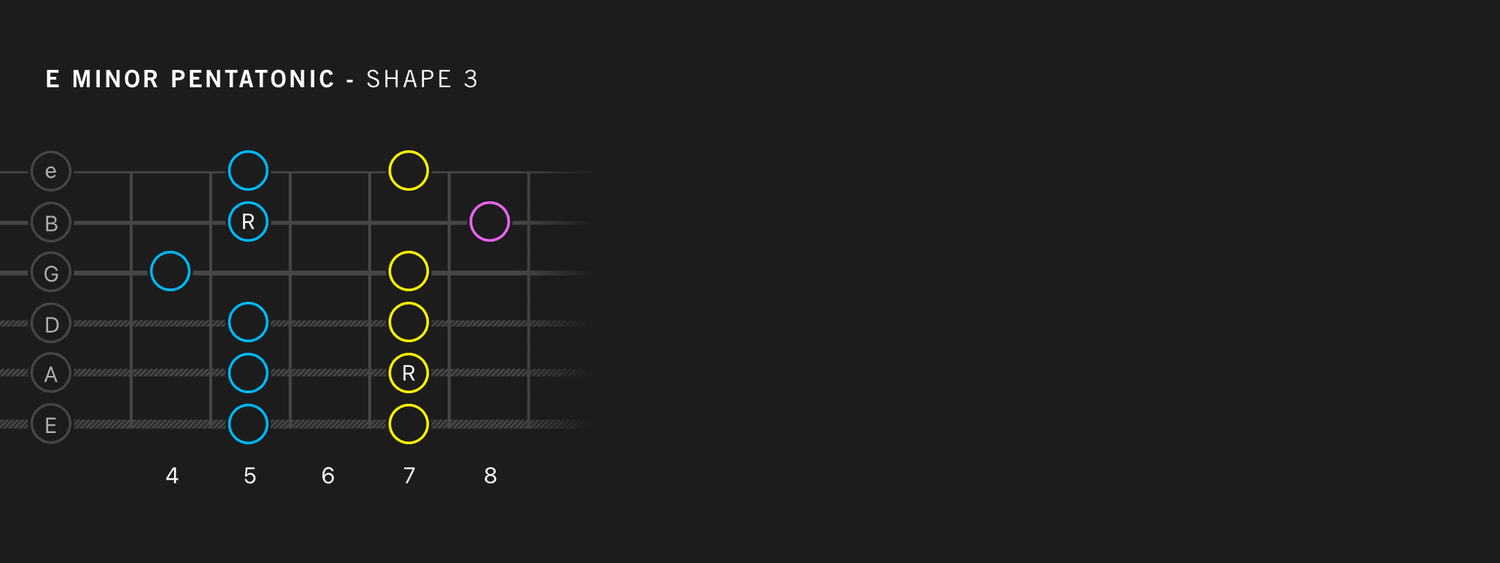
Where it lives: Centered around the 5th and 7th frets.
Why it's great: It has a very symmetrical, boxy feel on the lower strings, making it easy to play fast, repeating riffs (often called “blues licks”).
Shape 4: The “B.B. King Box” (Frets 7 to 10)
Now we are getting into the sweet spot of the guitar, where solos really start to sing.
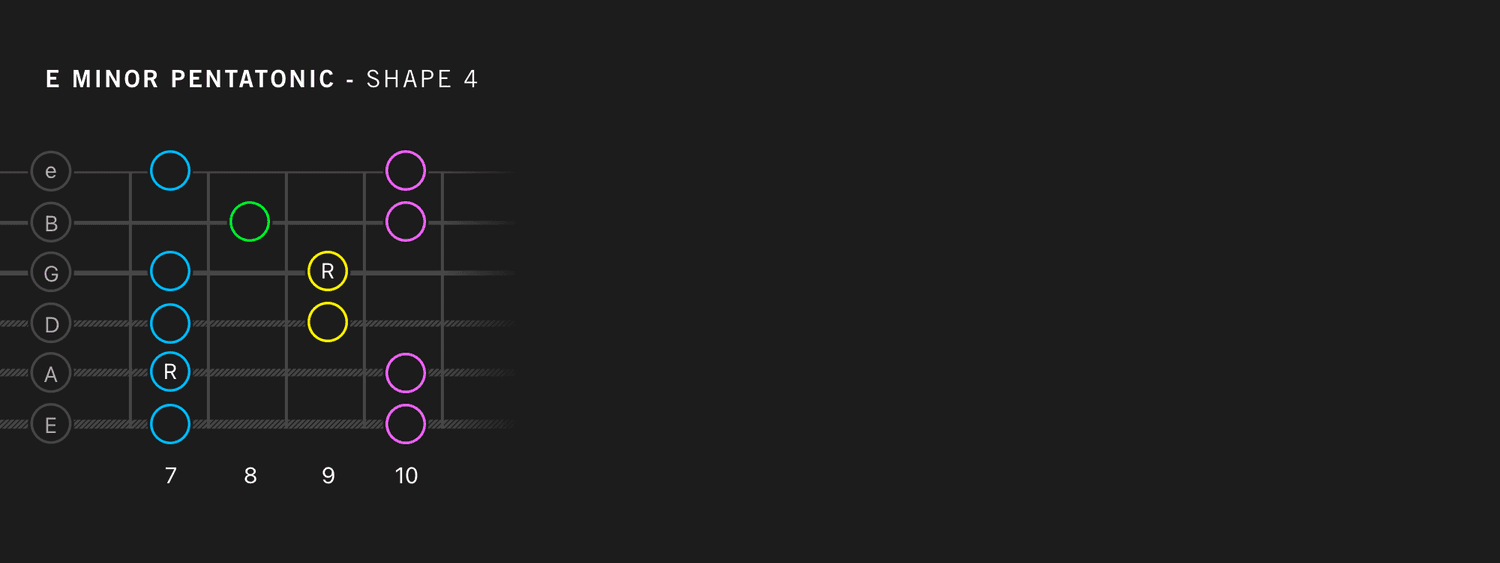
Where it lives: Starting around the 7th fret and extending to the 10th.
Why it's great: Legends like B.B. King and Albert King practically lived in this shape. It is fantastic for emotional, high-pitched string bends and vibrato on the B and High E strings.
Shape 5: The “Transition Box” (Frets 9 to 12)
This is the final interlocking piece of the pentatonic puzzle. It sits just below the 12th fret, serving as the ultimate gateway back into the high-octave version of Shape 1.
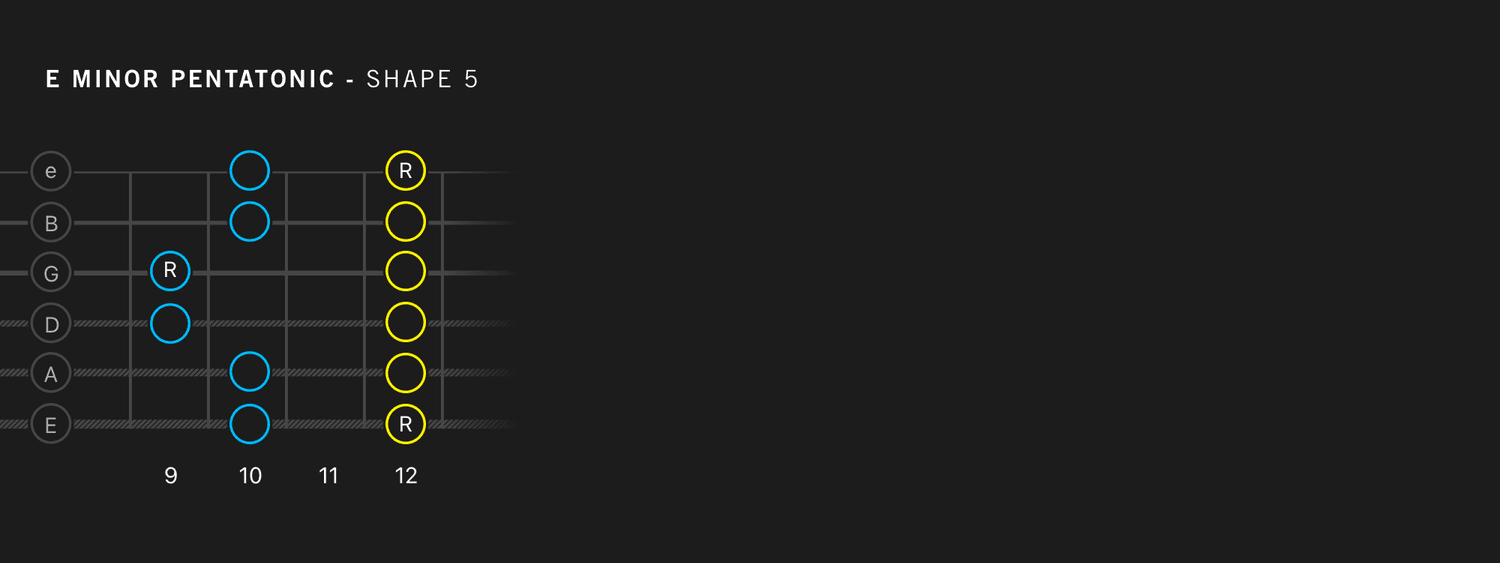
Where it lives: This shape typically begins around the 9th or 10th fret. It bridges the gap between the middle of the neck and the “Home Box” at the 12th fret.
Why it's great: It provides a smooth, ascending path for your fingers to climb into the high-register “sweet spot” of the guitar. Because it shares notes with the 12th-fret position, it's perfect for creating long, sliding lines that travel across the entire fretboard.
The “High Octave” Shape 1 (The 12th Fret Home)
Because the guitar repeats itself every 12 frets, your favorite Shape 1 (the Open Position Box) appears again at the 12th fret.
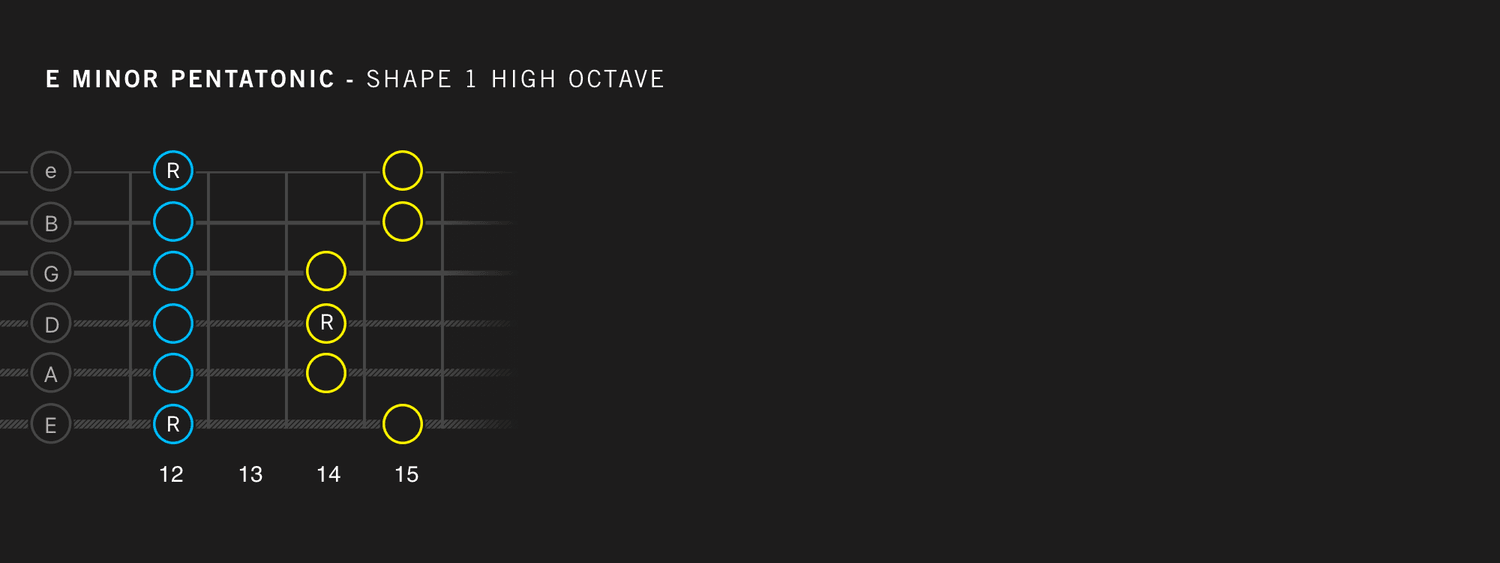
Where it lives: Starts with your index finger on the 12th fret of the Low E string.
Why it's great: It sits perfectly under your fingers and is the most comfortable and widely used spot for classic string bending. At this height on the neck, the notes ring out with singing sustain, making it the “Home Box” for legendary rock solos.
Troubleshooting: Why Do My Solos Sound Like “Just Playing a Scale”?
Memorizing the shapes is just step one. The biggest hurdle for beginners is that when they try to solo, it just sounds like they are running up and down an exercise.
The fix: Phrasing. Music is a language. If you just recite the alphabet (the scale up and down), it means nothing. You need to make words and sentences.
Use rests — Don't play constantly. Stop and let the backing track breathe.
Skip strings — You don't have to play the notes in order. Jump from the Low E string straight to the D string to create surprising intervals.
Target the root — Whenever a chord progression resolves, end your solo line on an ‘E’ note. It signals to the listener's ear that you have “come home.” This is exactly what practicing with Gibson App will teach you.
Start Simple
Begin by learning Shape 1 (the Open Position Box) inside-out. The open strings give you a safety net while you experiment and start improvising there. It will be overwhelming if you try to master all five shapes at once; start with one, find your voice, and then expand.
How the Gibson App Turns Scales into Solos
Practicing scales with a metronome in silence gets old fast. The Gibson App is built to make you sound musical from day one.
Never solo in silence — The app drops you into dynamic blues and rock backing tracks so every practice session feels like a jam, not a drill.
See exactly where to go next — With Gibson App gameplay you can practice each shape.
Know you're getting it right — The app's audio technology listens as you play, confirming you are hitting the right notes in rhythm and helping you build speed accurately.
Break Out of the Box
Learning the 5 shapes of the E Minor Pentatonic scale is the moment the guitar truly opens up for you. You are no longer confined to just open chords. The entire neck is yours to explore.
Grab your guitar, fire up a lesson or backing track, and let your fingers do the talking.

Frequently Asked Questions
Do I need to learn all 5 shapes right away?
Absolutely not. 90% of classic rock solos can be played entirely in Shape 1 (Open Position) or Shape 1 High Octave (12th Fret). Start there. Once you can comfortably play Shape 1 without looking, learn Shape 2 and practice sliding between just those two.
If I learn E Minor, do I have to relearn everything for G Minor?
No — that is the magic of the guitar. These 5 shapes are “moveable.” If you take Shape 1 High Octave and slide your whole hand down so your index finger is on the 3rd fret (a ‘G’ note), you are now playing the G Minor Pentatonic scale using the exact same finger patterns. Shape 1 is special because it uses open strings, but the other shapes move freely up and down the neck.
What is the difference between Minor Pentatonic and the “Blues Scale”?
They are almost identical. The Blues Scale is just the Minor Pentatonic scale with one extra note added — the “Flat 5” (also known as the “Blue Note”). In E Minor, that's the B♭ note. It adds a spicy, dissonant flavor to the shapes you already know.
Why is E Minor such a popular key for guitar?
E Minor is the most natural key on the guitar. Your two thickest strings (Low E) and thinnest string (High E) are already playing the root note when open. This means you can incorporate powerful open-string drones into your riffs and solos, creating a fuller, heavier sound with less effort. It's why so many classic rock and metal songs are written in E Minor.
What are the notes in the E Minor Pentatonic Scale?
The five notes are E, G, A, B, and D. These are the root, minor 3rd, 4th, 5th, and minor 7th of the E natural minor scale. These same five notes repeat across every octave on the guitar neck.
Can I use the E Minor Pentatonic over major chords?
Yes — this is one of the most powerful features of the pentatonic scale. You can play E Minor Pentatonic over both E minor and E major chord progressions. Over major chords it creates a raw, bluesy tension that defines the sound of rock and blues guitar.
What songs use the E Minor Pentatonic Scale?
Some of the most famous guitar solos and riffs of all time use E Minor Pentatonic: “Smoke on the Water” by Deep Purple, “Back in Black” by AC/DC, “Whole Lotta Love” by Led Zeppelin, “Comfortably Numb” by Pink Floyd, and “Sweet Child O' Mine” by Guns N' Roses.
How do I practice the pentatonic scale with a metronome?
Start slow — around 60 BPM — and play each note as a quarter note, ascending and descending through the shape. Once you can play it cleanly without mistakes, increase the tempo by 5–10 BPM. The Gibson App has built-in tempo tools that make this even easier by giving you backing tracks instead of a dry click.
How long does it take to learn the pentatonic scale?
Most beginners can memorize Shape 1 within a few days of practice. Playing it fluently and musically — with bends, slides, and confident timing — typically takes a few weeks. Learning all 5 shapes and connecting them across the neck usually takes a few months of regular practice.