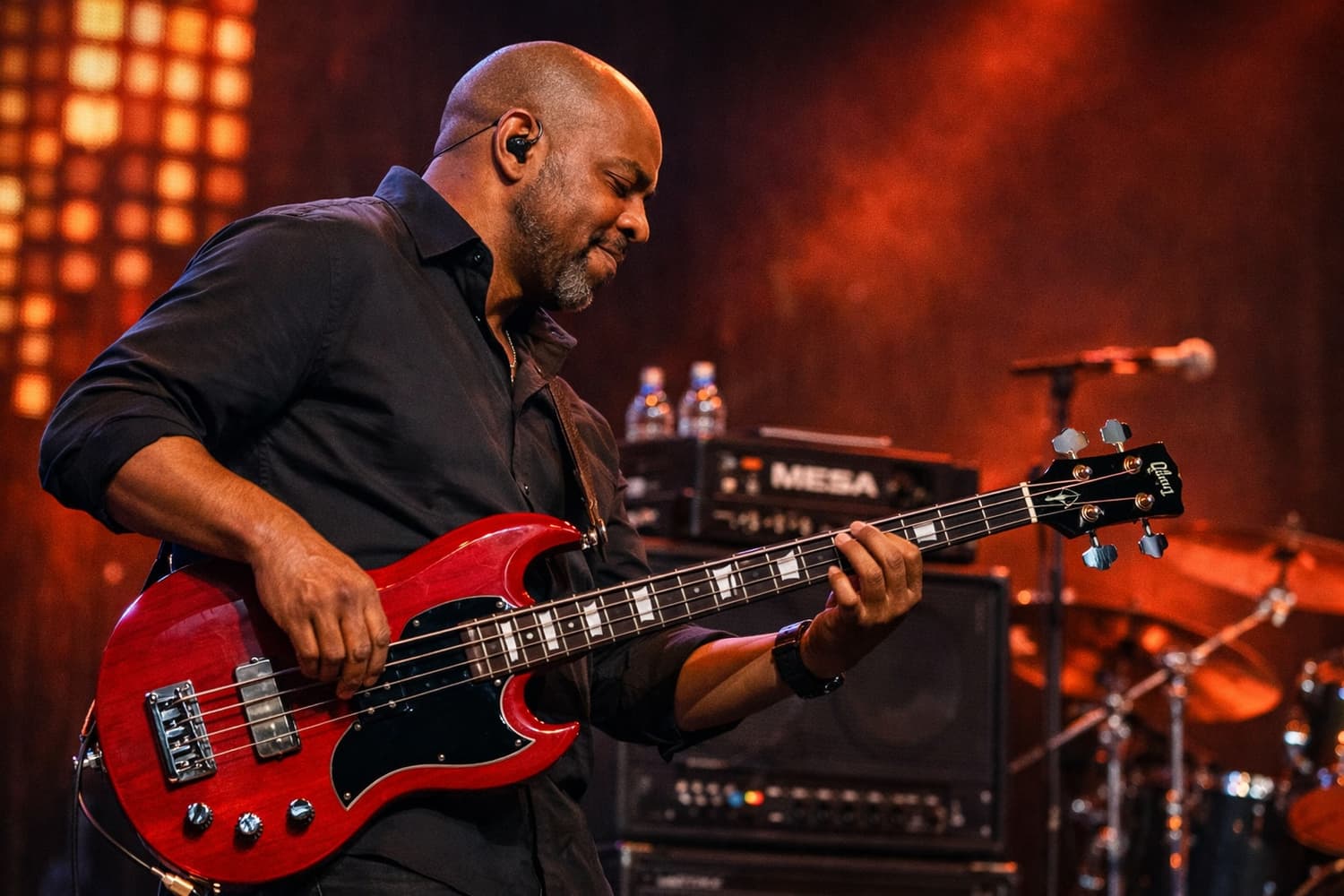
You've spent years locking in the groove, holding down the low end, and developing serious finger strength. Now you want to pick up a six-string. Maybe you're curious, maybe your band needs a rhythm player, or maybe you just want to write songs with chords instead of single notes.
Whatever the reason — the good news is you're not starting from zero. Not even close. Bass players have a genuine head start when learning guitar. Your fretting hand is already strong, your sense of rhythm is dialled in, and four of the six guitar strings are tuned to the exact same notes you've been playing for years.
But the transition isn't seamless either. There are real challenges that catch people off guard — and the sooner you understand them, the less frustrating the switch will be. This guide covers everything: what transfers, what doesn't, the common traps, and how to structure your learning so you're playing songs in weeks, not months.
What You Already Bring to the Table
Before we get into what's hard, let's talk about what's not. These aren't minor advantages — they're the reason most bass players progress through beginner guitar material two to three times faster than someone picking up a stringed instrument for the first time.
Finger strength and calluses. If you've been pressing heavy bass strings for a while, your fretting hand may already be quite strong. Guitar strings require significantly less pressure, so once you get the finger placement right, chord shapes can become surprisingly manageable. You might not need to go through the painful callus-building phase that new players dread — your fingers could already be battle-hardened. Many bass players who switch are shocked by how easy barre chords feel compared to the horror stories they've heard from guitarists.
Fretboard knowledge. The bottom four strings of the guitar — E, A, D, G — are tuned identically to your bass, one octave higher. Every note position, every scale shape, every interval you've memorized transfers directly. And here's something a lot of guitarists miss: if you know those lower positions well, you may actually have a wider range than most lead players who tend to live on the top four strings. One bass player on Reddit put it well: “Without even trying I could suddenly shred in the lower register. Knowing patterns on the bass opened up my range.”
Rhythm and timing. Bass players are often the rhythmic backbone of any ensemble. If you've developed that ingrained sense of groove — the ability to lock in with a drummer and hold a pocket — it can make learning strumming patterns and rhythm guitar feel much more natural. This is something that takes non-musicians months to develop, and you might already have a head start.
Music theory in practice. You might already have a working understanding of chord progressions, key signatures, and song structure. If someone hands you a chord chart, you may not be staring at it blankly — you could already see possible notes across the fretboard. Rather than learning theory from scratch, you may just be adding chord voicings to harmonic concepts you've been exploring on bass.
Finger independence and fingerstyle chops. Bass techniques like fingerstyle plucking, hammer-ons, and pull-offs can translate directly. Your pinky finger may already be stronger than most beginner guitarists' — and some players find that after going back and forth between instruments, their weaker fingers get dramatically stronger on both. The crossover from fingerstyle bass to fingerstyle guitar is particularly smooth.
Ear training. Here's one that surprises people. After playing bass and having to inhabit the lower register, you develop a much better understanding of where instruments sit in a mix. You think about sound in terms of frequency space, not just volume. When you switch to guitar, you may already have an instinct for how to play parts that complement the rest of the band rather than fight for space. That's ensemble awareness that most new guitarists take years to develop.
How Guitar Tuning Relates to Bass
This is one of your biggest advantages, and it's worth understanding clearly before you touch a guitar.
Bass Guitar (Standard)
4 strings — low to high
Guitar (Standard)
6 strings — 4 shared + 2 new
Every scale shape and note position you've memorized on bass works identically on those four strings — just one octave higher. The B and high E strings extend the range upward and are essential for chord voicings and melodies. Pentatonic and blues scale shapes in particular are nearly identical across both instruments — your hands already know the shapes, they just need to recalibrate for the smaller fret spacing.
The Real Challenges of Making the Switch
Your bass background is a genuine advantage. But here's where it gets honest — the transition still has friction, and pretending otherwise sets you up for frustration. These are the areas where bass players actually struggle.
“What is this, a bass for ants?”
This is far and away the most universal reaction. After years on a 34" scale bass, a guitar's 24.75" or 25.5" scale length feels comically small. The frets are closer together, the strings are thinner, the string spacing is tighter, the whole instrument feels like a toy. Almost every bass player who switches describes this exact sensation.
The upside is that your reach is suddenly enormous — things that were impossible stretches on bass become easy on guitar. The downside is that your movements need to be smaller and more precise. Overshooting frets and accidentally muting adjacent strings are the two most common frustrations in the first few weeks. Let your hand relax, keep your thumb behind the neck, and remember: accuracy matters more than pressure on guitar.
Chords are a completely new motor skill
On bass, you mostly play one note at a time. Guitar requires pressing multiple strings simultaneously to form chords, then strumming them all cleanly — that's an entirely new coordination task even if you've been playing bass for fifteen years. The mental model shifts from “which note am I playing?” to “which shape are all five fingers making right now?”
Start with two-finger chords like Em and Am, then build up to full open chords. The muscle memory develops faster than you'd expect because your fingers already know how to work independently — they just haven't done this particular kind of teamwork before.
Your right hand has to learn a completely different job
This one catches people off guard. On bass, your plucking hand works individual strings with precision. On guitar, you're strumming across multiple strings in fluid motions — and keeping a steady strumming pattern while changing chords underneath is a real coordination challenge. Several bass players report that left-and-right hand coordination is actually harder than they expected, especially with tremolo picking and quick string changes.
Start with all-downstroke strumming on simple progressions and add upstrokes once the motion feels natural. Many bass players find hybrid picking — a pick combined with middle and ring fingers — feels intuitive since it draws on existing plucking technique. As for pick thickness: you might be tempted to stick with the heavy picks you're used to from bass (some players swear by 2mm+), but try a medium pick (0.73–0.88mm) for strumming — it's more forgiving across multiple strings.
The non-wound strings feel impossibly thin
String size is a double-edged sword. Your years of bass playing give you the strength to make bends and vibrato effortless on guitar — but the unwound G, B, and high E strings suddenly feel like they're barely there. They require a more precise touch to hit accurately, and your picking hand needs to recalibrate for strings that are a fraction of the diameter you're used to. This is especially noticeable when trying to pick individual notes on the thinner strings — you'll overshoot or undershoot them at first.
You have to learn to fill sonic space differently
As a bass player, you're used to locking in with the drums and providing the low-end foundation. Guitar occupies a completely different sonic space — you're laying down harmony, rhythm, and sometimes lead melodies all at once. The mental shift from “support the band from underneath” to “fill the mid-range with chords and texture” takes time.
One thing that really helps with this shift: remember that on guitar you often don't need to play the root note in the bass of a chord. That's the bassist's job. As a bass player you may be instinctively drawn to voicings that hammer the root on beat one — it's what you've been doing for years. But on guitar you can free yourself from the root entirely: play chord inversions where the 3rd or 5th is the lowest note, add colour tones, or start a melodic phrase on an unexpected beat. Letting the bass handle the foundation and playing something complementary on top is what makes a guitar part sit well in a band.
Interestingly, many bass players who switch say this experience actually makes them better at both instruments. Learning how guitar parts and bass parts fit together in a mix gives you an understanding of ensemble playing that goes from two-dimensional to three-dimensional. You start hearing songs as interlocking frequency spaces rather than just separate instrument parts.
Singing while playing might actually get easier
Here's one that might surprise you: many bassists find it easier to sing while playing guitar than while playing bass. On guitar, your strumming hand can settle into a repeating pattern that almost runs on autopilot — freeing up mental bandwidth for the vocal melody. On bass, the picking hand plays more specific, syncopated rhythms that often differ from the vocal line, which makes the coordination genuinely harder.
If you've already been singing over bass lines, guitar strumming may feel like a relief by comparison. The steady down-up motion locks to the beat in a way that leaves your voice free to do its own thing. It's a pleasant upside that bass-to-guitar switchers don't always expect.
Mistakes Bass Players Commonly Make
Knowing these ahead of time can save you weeks of bad habits.
Pressing too hard. Bass strings demand serious pressure. Guitar strings don't. Pressing too hard causes sharp intonation, faster hand fatigue, and can even bend notes out of tune. Dial it back to the minimum pressure needed for a clean sound — you'll be surprised how little that is.
Hiding on the low four strings. It's tempting to stay on the familiar E-A-D-G and avoid the B and high E. But chord voicings and melodies depend on those top strings. Force yourself to practice on all six from day one — otherwise you'll develop a lopsided technique that gets harder to fix the longer you wait.
Playing guitar like a bass. Bass players instinctively play single-note lines. Guitar is fundamentally a chordal instrument. Some players who switch say they learned to “sit back and let the song breathe, peaking out in moments where a lead is needed” — and while that musical restraint is admirable, you also need to embrace the harmonic, strumming side of guitar early. It's the fastest path to sounding good.
Always playing the root on beat one. This is a very common bass-player habit. On bass you're usually anchoring the harmony with root notes — but on guitar, especially in a band context, you can let the bassist handle the root and play chord voicings that skip it entirely. Try inversions, add upper extensions, or start phrases off the downbeat. It opens up a whole new world of textures and makes you a far more interesting rhythm player.
Skipping strumming practice. Your right hand has a completely different job on guitar. It's easy to focus all your practice on learning chord shapes and neglect the strumming hand. Dedicate specific time to strumming patterns — the coordination between both hands is where the real skill lives.
Not adjusting your thumb. Bass players often wrap their thumb over the top of the neck. While this works for some guitar techniques (Hendrix used it constantly), most chord shapes require the thumb behind the neck for proper finger reach and leverage. Be intentional about thumb placement, especially when learning open chords.
Where the Gibson App Fits In
Most guitar learning apps assume you've never touched a stringed instrument. They start you with how to hold a pick, how to press a single fret, how to count to four. For a bass player, that feels like being sent back to kindergarten.
The Gibson App is structured differently. It has a clear learning path broken into distinct sections — and you can skip the ones you've already outgrown.
The learning path
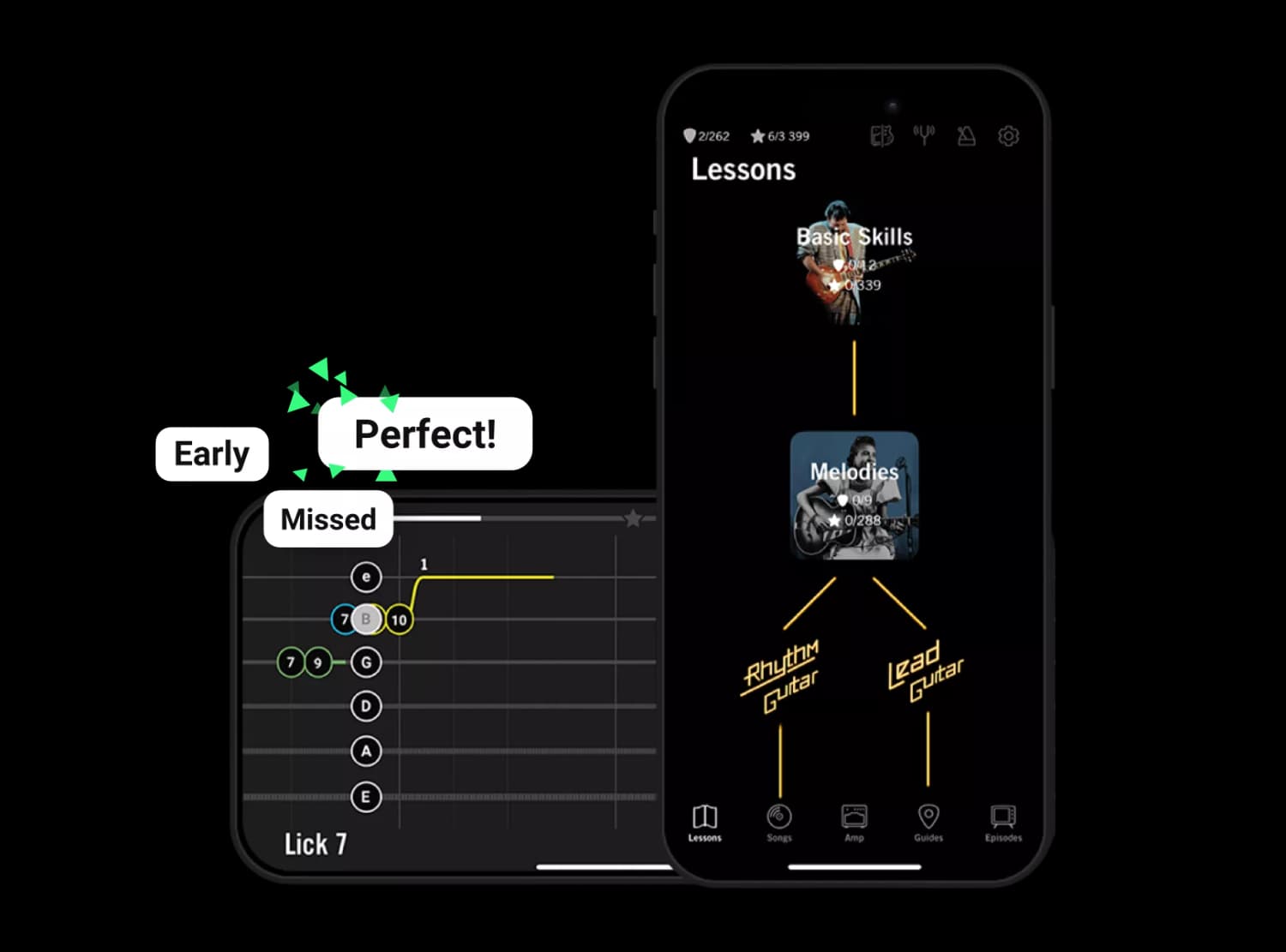
The app organizes lessons into a beginning path, a rhythm guitar path, and a lead guitar path. Here's what each contains and which ones you can skip.
Beginning Path
Skip thisBasic Skills — Learn the basics and build a strong foundation. Get familiar with the tablature and gameplay, develop your timing and rhythm, and learn to play frets and basic melodies. 120 lessons · 64 videos
Melodies — Discover how to play world-famous melodies on the higher frets over multiple strings, with tips for developing muscle memory. 113 lessons · 62 videos
As a bass player you may already have the timing, rhythm, fret knowledge, and muscle memory these courses build. If so, feel free to jump past them.
Rhythm Guitar Path
Start hereOpen Chords — Learn Em, G, D, C, Am, E, and A. Each chord is taught individually, then combined into progressions with famous songs. Three parts that take you from your first chord to fluid transitions. 222+ lessons · 98+ videos
This is where your guitar journey begins. Your finger dexterity means you'll likely move through chord shapes faster than most — the real skill to develop here is strumming coordination.
Lead Guitar Path
When you're readyPower Chords — These will feel instantly familiar from bass. Essential for rock, punk, and metal. 46 lessons · 19 videos
Licks — 10 essential licks to start jamming and playing along with songs. 60 lessons · 25 videos
Riffs — One-string and multi-string riffs, open power chords, and power chord riffs across rock, blues, pop, and metal. 58 lessons · 18 videos
Real-time feedback as you play
The app listens through your phone mic and tells you in real time whether you're fretting and strumming correctly. No guessing — you'll know immediately if a chord rings clean or if you're muting a string. Your progress is tracked across ~270 individual skills, so you can see exactly where you're strong and what needs work.
7-day free trial · Use code BASSTOGTR for 20% off
Go Deeper: Guides, Songs & Styles
Once you've got the chord basics down, the Gibson App goes well beyond chord charts. There are guided deep dives into specific playing styles — full courses that break down the techniques of legendary guitarists into learnable steps.
Play like Brian May. Learn the signature harmonized guitar lines, the Red Special tone techniques, and the iconic riffs that defined Queen's sound. Broken down step by step from basic harmony to the full multi-layered arrangements.
Gods of Rock. A curated series exploring the techniques and styles of rock's greatest guitarists — from power chords to face-melting solos, each with video guides and interactive lessons.
The Jimi Hendrix Experience. Dive into Hendrix's revolutionary approach: thumb-over-neck chords (which, as a bass player, you might already do naturally), double stops, wah-wah techniques, and his unique blend of rhythm and lead playing. Hendrix is actually an interesting study for bassists switching over — his style blurred the line between bass-like riffing and chord work.
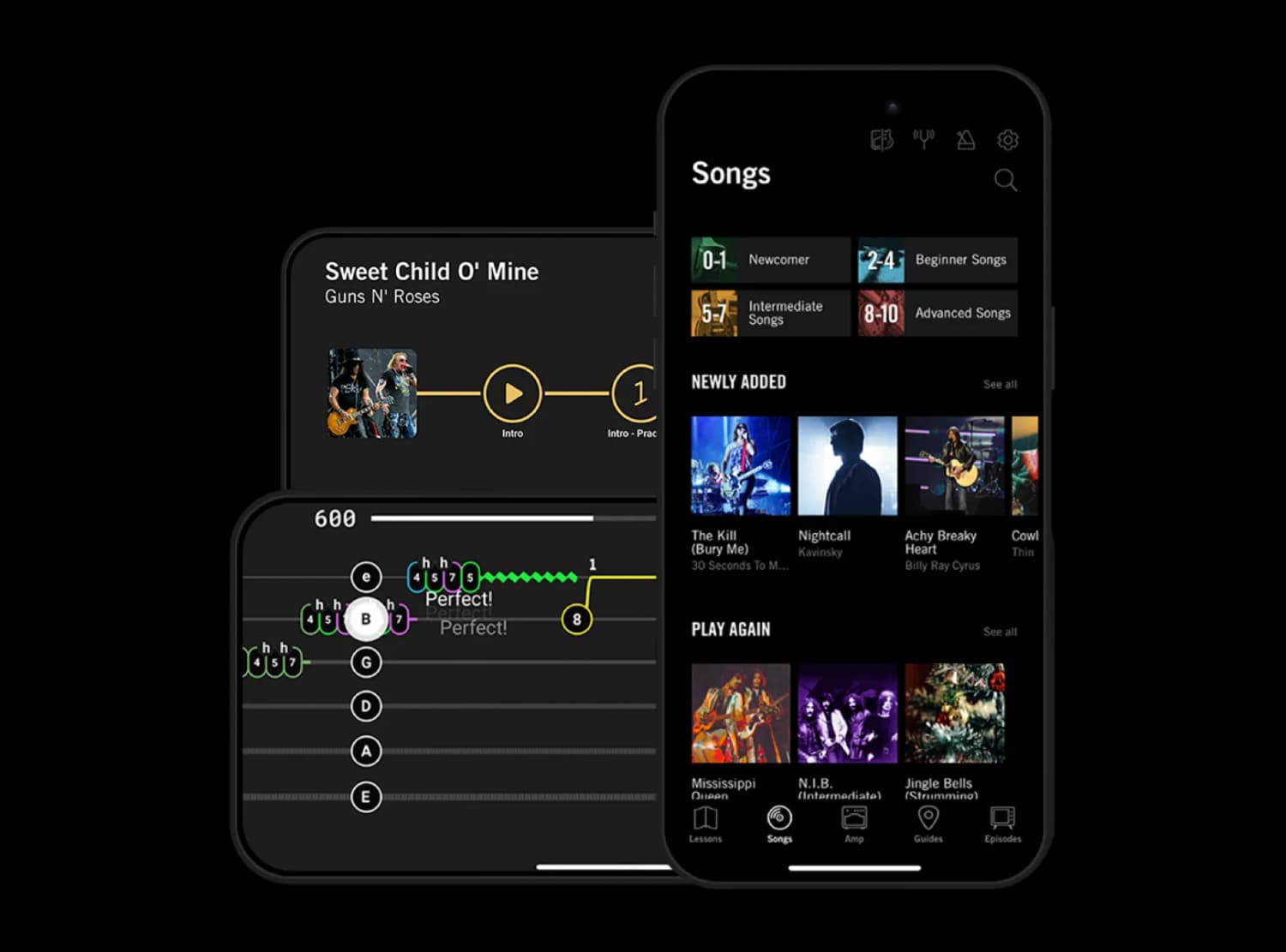
There's also a full library of famous songs you can play along to, with chord charts, strumming patterns, and real-time feedback on every one. Your sense of rhythm from bass will make these feel natural fast.
Want to see everything available? Explore the full Gibson App content library →
Ready to start with the basics? Learn guitar from scratch → or jump straight to guitar chords.
A Realistic Timeline
Here's what most bass players experience when they start learning guitar. Your mileage will vary, but this gives a realistic sense of the progression.
Weeks 1–2
Open chords & basic strumming
Learn Em, Am, G, C, D, and A. Practice switching between them smoothly. Start with simple down-strum patterns. Your finger strength means chord shapes come fast — the challenge is the strumming coordination.
Weeks 3–4
Chord transitions & first songs
String chord progressions together — G-C-D, Am-Em-G. Play your first complete songs. Add up-down strumming. This is where bass players start feeling that “I can actually do this” moment.
Months 2–3
Barre chords & power chords
Your bass finger strength makes barre chords significantly easier than for most beginners. Learn F major, B minor, and moveable barre shapes. Power chords will feel instantly familiar — they're essentially the same shapes you've been playing.
Months 3–6
Style exploration & deep dives
Explore pentatonic soloing (shapes you may already know from bass), fingerpicking patterns, and rhythm techniques. Dive into the Gibson App's artist guides. This is also when many bassists start noticing that playing guitar is making their bass playing better too — you start seeing chord tones and passing notes differently.
6 months +
Finding your voice on guitar
Combine rhythm and lead, improvise over progressions, develop your own style. Your musical maturity from bass means you'll approach this with more nuance than most guitarists at this stage. Many players find that the two instruments spur each other on — creatively, technically, and musically.
The Two-Instrument Advantage
Something that almost every bass-to-guitar player reports: learning guitar makes you a better bassist, and vice versa. It's not just a nice sentiment — the cross-pollination is real and tangible.
Learning chords on guitar can give you a deeper understanding of the harmony you may have been outlining on bass. You might start seeing chord tones differently — knowing which notes are the roots, 3rds, 5ths, and 7ths makes your bass lines more intentional and musical. Players who only ever played bass say they would probably never have spent the time learning chord tones otherwise.
Going the other direction, your bass experience gives you a sense of musical restraint that most guitarists lack. You may already know how to serve the song, how to leave space, and when to step forward. That's a rare quality in a guitarist — and it makes you the kind of player that other musicians love working with.
And honestly? Bassists get gigs. If you can do both, your value in any musical situation goes through the roof.
Frequently Asked Questions
Common questions from bass players considering the switch.
Is it hard for a bass player to switch to guitar?
Can I skip the beginner guitar lessons if I already play bass?
What are the biggest differences between bass and guitar?
Will my bass skills help me learn guitar faster?
Should I use a pick or my fingers when switching to guitar?
What type of guitar should a bass player start with?
How long does it take a bass player to learn guitar?
What should I learn first on guitar as a bass player?
Do guitar and bass share the same notes and scales?
Can I use the Gibson App to learn guitar as a bass player?
Will switching to guitar make me worse at bass?
Ready to Make the Switch?
You may already have a strong foundation. The Gibson App gives you a structured path to build on your bass skills — skip the basics, start with chords, and play real songs. Try it free for 7 days.
7-day free trial · Use code BASSTOGTR for 20% off