3-Month Beginner Guitar Practice Plan (Week by Week)
A week-by-week practice plan for your first 3 months on guitar, from your first notes to strumming songs or playing riffs. Follow it on your own or in the Gibson App.
This is a 3-month beginner guitar practice plan: 15 to 20 minutes a day, on at least 3 days a week, from your first notes to your first songs. Month 1 is single notes and melodies, month 2 adds simple chords and finger strength, and in month 3 you choose to strum full songs or play rock riffs.
How long does it take to learn guitar? Measured across more than 90,000 Gibson App learners, the basics take about 13 hours of lessons, about 35 short practice sessions over about 5 weeks. The full data is in how long it takes to learn guitar. This plan is how to spend those first weeks.
Follow this 3-month plan with feedback
The plan below is built on the Gibson App curriculum. The app listens while you play and shows what to fix (real-time feedback on iOS). Try it free for 7 days.
TRY 7 DAYS FREEWhat you can play after 3 months
| After | What the plan covers |
|---|---|
| Month 1 | Holding the guitar and pick, single notes on the top strings, your first melodies and riffs |
| Month 2 | More fingers and strings, simplified chords, melodies from famous songs |
| Month 3 | Your choice: strumming full songs with open chords (Strummer) or power-chord riffs (Riffer) |
Practice in short sessions on most days rather than one long session at the weekend. Gibson App learners who played on 5 or more days in their first week were about 20 times as likely to still be playing a month later as those who played once. Use a metronome to keep sessions focused, and tune with the online guitar tuner before you start.
This plan was written by guitar instructor Jamie Humphries and updated by the Gibson App team in November 2026.
Pick It Up and Play: A 3-Month Beginner Guitar Journey
Let’s now take a look at a realistic practice/progress timeline designed to fit around day-to-day life, taking into consideration your other commitments such as school, college, work, family, and free time activities. Here's a simple, beginner-friendly practice framework:
- Duration: 15–20 minutes per day
- Frequency: 3 days a week, daily if possible
- Focus: Quality over quantity. Shorter, regular sessions are more effective than occasional long ones.
Every minute playing guitar counts. If you’re pressed for time, even picking up the guitar for a few minutes is better than skipping entirely. When sitting down to practice, try to find a quiet place out of the way of others so you can play with confidence and without interruptions. You may feel a little self-conscious when you first start, and that’s okay – it will pass. Having some privacy is important; remember, you’re learning, and that takes time and dedication.
Another benefit of shorter, regular practice sessions is that your fingers may experience some discomfort in the beginning. Since pressing your fingers on the strings can make them sore at first, easing into the physical side of playing is key.
In the following section, we’ve outlined a full 3-month practice routine designed to take you from your first notes to performing your first songs. The routine presents a series of easy-to-digest tasks based on sections of the curriculum within the Gibson App, divided by month.
- In Month 1, you’ll get to know your guitar, how to hold it, pick notes, and start using your fingers to play simple riffs and melodies.
- In Month 2, you’ll begin combining melodies with simplified chords, develop finger strength and memory, and learn to switch between strings and frets.
- By Month 3, you’ll be ready to choose your path. If you love the feel of playing full songs with open chords and strumming along, the Strummer route is for you. If you’re more into riffs, power chords and the heavier sound of rock rhythm guitar, go with the Riffer path. Both tracks build on what you’ve learned – just with different vibes.
This plan is built from the way that countless people have learned to play guitar in the Gibson App – a virtual guitar coach, with easy-to-follow interactive tabs. The Gibson App actually listens to you, providing real-time feedback as you perform. With the help of AI, the app gives you personalized insights into your strengths and areas of improvement – just like a real guitar teacher. But above all, it’s an inspiring platform to learn with: you’ll be jamming to a backing track in your very first lesson!
The Gibson App also lets you decide the type of player you wish to become, as well as the style of music you want to play. Different practice genres help you become a more versatile player.
A Realistic 3-Month Practice Plan
Month 1 – Chords and Melodies
Week 1
- How to hold the guitar
- How to hold the pick
- String names and how to tune the guitar
- Picking the thinnest string, open (the high e string)
- Fretting with index finger on the E string
Week 2
- Playing 2 frets with the index finger
- Playing 3 frets with index finger
- Play "Born To Be Wild" (simplified)
Week 3
- Adding the B string (second thinnest string)
- Practice melody on the B and E string
- Practice "Whisky In The Jar" adding the middle finger
Week 4
- Learn the E minor chord
- Learn the G major chord (simplified)
- Play "Paranoid" including the E minor chord
Month 2 – Chords and Melodies
Week 1
- Play "Ironic" adding the ring finger combining with index finger
- Play "Sweet Child O' Mine" combining all 3 fingers
- Play "Smoke On The Water" practice memorizing melody
Week 2
- Play "American Girl" with melody on the G string
- Play "Yellow" including multiple string melody
- Higher frets: Practice finding frets on the G, B and E strings
Week 3
- Play "Let It Be" melody
- Play "White Rabbit" working on finger muscle memory
- Play "Brown Eyed Girl" including the G major chord (simplified)
Week 4
- Play "Silent Night" additional melody practice (free tab: Silent Night on guitar)
- Memorizing melodies: play "Ode To Joy"
- Practice changing between E minor and G major (simplified)
Month 3
Strummer
Week 1
- Learn the D major chord
- Practice strumming
- Play "Sweet Child O' Mine" simplified version with the D major chord
Week 2
- Learn the C major chord
- Practice changing between all the chords learned so far
- Play "Every Rose Has Its Thorn"
Week 3
- Learn the A minor chord
- Play "Ain't No Sunshine" combining chords
- Learn the E major chord
Week 4
- Learn the A major chord
- Play "I Can't Explain" combining chords
- Learn the D minor chord
Riffer
Week 1
- Learn the A5 power chord (E string root)
- How to move a power chord shape to form new power chords
- Play "Breaking The Law"
Week 2
- Learn the A string power chord shape
- Move the A string power chord shape to form more chords
- Play "Paranoid"
Week 3
- Practice changing between E and A root power chords
- Additional E power chord practice: play "Breakdown"
- Practice muting when strumming power chords
Week 4
- Additional A power chord practice: play "Wishing Well"
- Play "We're Not Gonna Take It" combining E and A power chords
- Riff basic: learn a one-string riff
The Truth About Progress: It's Personal (and That’s Okay)
Learning guitar takes time. It’s not a race – and those first days, weeks, and months are crucial. Some people pick it up quickly, while others take more time, and that’s totally normal. If it takes longer for you, don’t be discouraged. One of the best pieces of advice? Don’t put pressure on yourself. A relaxed, enjoyable pace leads to better, longer-lasting results.
You need regular, consistent practice. Like any skill, learning guitar takes discipline, patience, and time. Consistency beats intensity. Even 15 focused minutes a day can make a difference. The more you practice, the better you get. The better you get, the more fun it becomes. Progress builds naturally if you let it.
Another tip: always play something new. A new chord, melody, or riff keeps you curious and motivated. Next time you reach for your phone, try picking up your guitar instead! Just a few chords can give you that “Wow, this actually sounds pretty good!” feeling that many instruments don’t offer so quickly. Remember: every great guitarist was once a beginner. There’s no such thing as “too slow” – only forward.
Getting the Most from Your Practice Routine
Here are the questions beginners ask most, and how the 3-month plan and the Gibson App help. If you want to speed up the first months, see our steps to learn guitar fast.
Is learning guitar hard?
It can be, depending on how you approach it. Jumping straight into full chords can be frustrating – especially switching between shapes and strumming at the same time. This is where some people give up. A better way? Start with single-string melodies. They’re easier to play and sound great even on your first day. The Gibson App helps here: your first lesson includes a simple melody with a full-band backing track, making the experience inspiring and fun. So, in the words of Radiohead: “Anyone Can Play Guitar!”
How long does it take to learn acoustic guitar?
It depends on your expectations and how regularly you practice. Mastery can take years, but within 3 months, you’ll likely be playing recognizable riffs and strumming basic songs. In 6–12 months of regular practice, you’ll be able to confidently perform a wide variety of songs and start developing your own style.
How long does it take to learn electric guitar?
To become a shredding virtuoso might take years, but basic riffs? Just weeks. Power chords – core to rock – are quick to learn, and once you understand how to move shapes around the neck, your riff library will grow fast. Add in some basic scales, like the minor pentatonic, and you’re on your way. A realistic timeline:
- 3 months: playing simple songs with power chords and basic riffs
- 6 months: starting to learn scales and improve technique
- 1 year: confidently tackling full solos and more advanced material
How long does it take to learn all the chords?
Understanding chord theory is deep and takes years, but learning basic major and minor chords happens relatively quickly. With just a few open chords, you can play countless songs. Moving on to 7th chords and barre chords takes more time, but it’s doable within 6 months of focused practice. With barre chords, you can play in every key using one shape!
How long and how often should I practice?
There are no shortcuts – practice makes progress. You don’t need marathon sessions. Play for 15–20 minutes, 3–5 times per week. Daily is even better. What matters most is routine and consistency. Short, focused sessions beat infrequent long ones. Find a regular time and space, and protect it. Consistency is the key to growth.
How does the 3-month plan help me learn guitar?
The 3-month routine is based on the Gibson App curriculum, offering around three tasks per week. You'll start with mechanics – holding the guitar, basic picking – and gradually layer on more complexity with riffs and chords in real songs. The App provides structure, backing tracks, and real-time feedback, helping you stay motivated and inspired. As you progress, it listens to your playing and gives smart feedback and suggestions. Following this path gives you a clear sense of progression, and prepares you for any style or direction you want to take.
Final Words
There is no time limit on learning. Learning guitar should be fun. There’s no such thing as too slow – there’s only forward. What’s motivating is that with just a handful of chords, you can already play a song. You strum a few chords and suddenly it’s like: Wow, this actually sounds pretty good!
Not many instruments give you that kind of reward so early on. So keep going. Every minute playing is progress. And remember – every great guitarist was once a beginner.
So next time you’re asking yourself how long it takes to learn guitar, just remember: the more you enjoy the journey, the faster progress will come.
Start month 1 today
Your first lesson in the Gibson App is a simple melody with a full-band backing track. Try it free for 7 days.
TRY 7 DAYS FREEFrequently asked questions
What should a beginner guitar practice plan include?
Short sessions of 15-20 minutes on at least 3 days a week, starting with single notes and melodies, then simple chords, then a choice between strumming songs and playing riffs. This plan covers that in 3 months, about three tasks a week.
Can I learn guitar in 3 months?
Yes, the basics: Gibson App learners needed about 13 hours of lessons (median) to learn them, which fits into 3 months at about 15 minutes on 5 days a week. See the full data on how long it takes to learn guitar at gibson.app/how-long-does-it-take-to-learn-guitar.
How long should I practise guitar each day?
15-20 minutes is enough for a beginner, at least 3 days a week and daily if you can. Short, regular sessions work better than long, rare ones.
Is it faster to learn electric or acoustic guitar?
Basic riffs and power chords on electric guitar come within weeks. On either guitar, simple songs take about 3 months of regular practice.
How long does it take to learn barre chords?
Barre chords and 7th chords usually come after the open chords, within about 6 months of focused practice.
Continue in the Gibson App
The best guitar learning app for beginner and intermediate players.
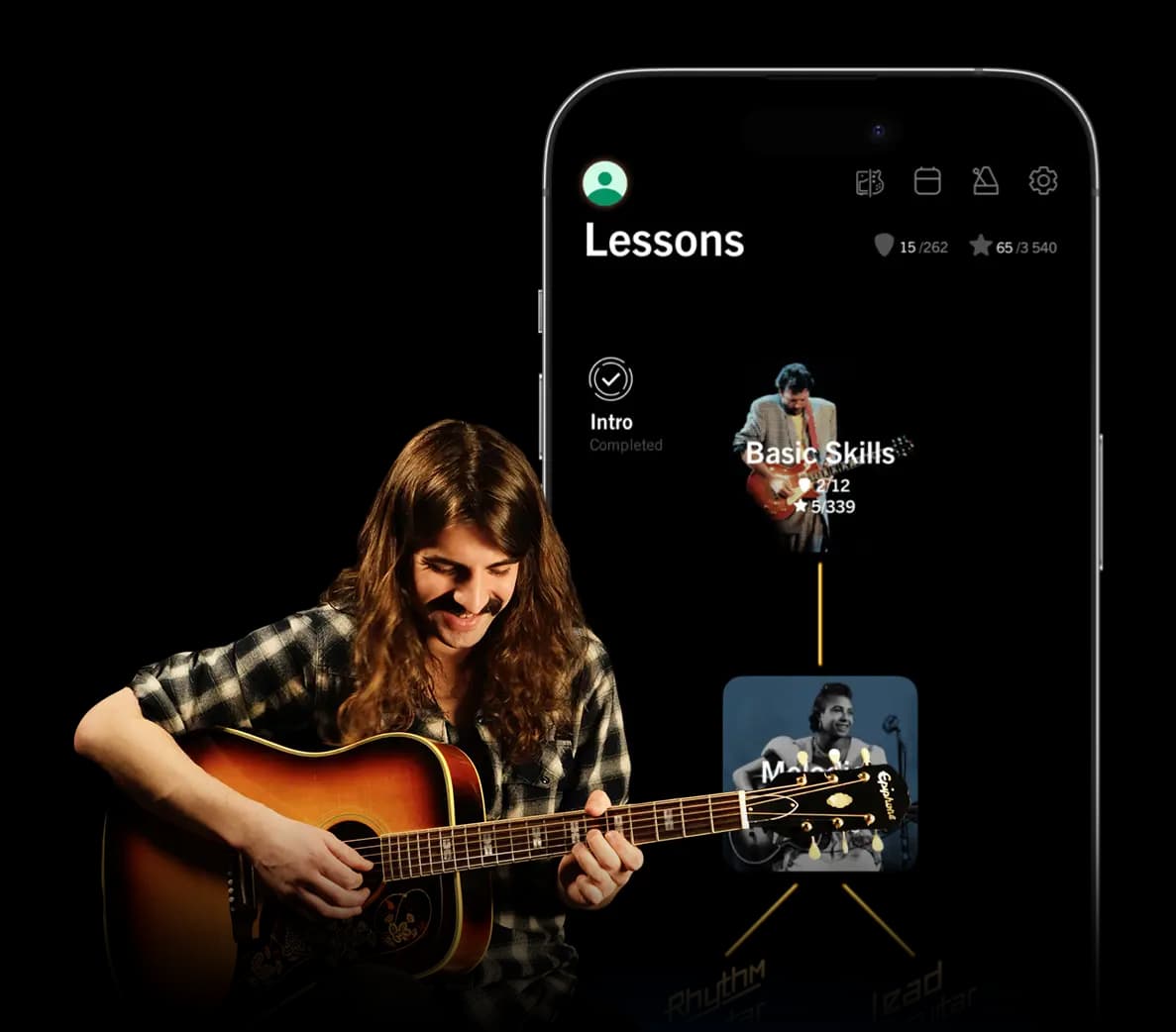
You can explore the full version of this course inside the Gibson App — along with step-by-step lessons, real-time feedback, and a personalized path designed to take your playing to the next level.
 Real-time feedback: The app listens while you play and gives instant visual and audio feedback.
- 🎮 Interactive gameplay with real song backing tracks.
- 🏆 Weekly leagues to compete and climb leaderboards.
- 🧭 Structured learning paths for step-by-step courses.
- ⚡ Deep-dive guides & genre courses to learn like the pros.
Continue in the Gibson App
The best guitar learning app for beginner and intermediate players.
You can explore the full version of this course inside the Gibson App — along with step-by-step lessons, real-time feedback, and a personalized path designed to take your playing to the next level.
- Real-time feedback: The app listens while you play and gives instant visual and audio feedback.
- 🎮 Interactive gameplay with real song backing tracks.
- 🏆 Weekly leagues to compete and climb leaderboards.
- 🧭 Structured learning paths for step-by-step courses.
- ⚡ Deep-dive guides & genre courses to learn like the pros.
Related Articles

From the Gibson App learning data

Jamie Humphries
2025-07-10 · Updated 2026-11-11