Unleash Your Inner Rockstar: A Beginner's Guide to Rock Guitar
Discover the roots and evolution of rock guitar with this beginner's guide.
About the Course
Welcome to the world of rock guitar! In this beginner's course, you'll explore the roots and evolution of rock music, from its iconic sound to its cultural influence. Whether you're strumming on an acoustic or cranking up the gain on your electric guitar, this course will help you discover the fundamental elements that form the sound of rock guitar. You'll learn a variety of techniques and approaches that focus on the essence of rock, from creating a powerful tone to embellishing it with effects that have shaped rock music through different eras.
This article focuses on Chapter 1, the starting point of the full course available inside the Gibson App. Chapter 1 lays the foundation for your rock guitar journey, introducing you to the core sounds and techniques that define the genre. As you progress through the course, you'll gain the skills and confidence to create your own rock riffs, solos, and songs. Whether you're playing on an electric or acoustic guitar, you'll be surprised how quickly these techniques become part of your sound.
Chapter 1
Introduction To This Course
The Sound of Rock Guitar
In this course, we explore the fundamental elements that form the sound of rock guitar, introducing them in an easy-to-follow manner. We'll delve into various techniques and approaches that focus on the essence of rock sound. You'll learn how to create a rock guitar tone and enhance it with different effects that have shaped rock music through the ages. The core of this course is to get you started in the genre and equip you with the tools to achieve the rock sound. Whether you have an electric or an acoustic guitar, the ideas presented here will get you playing and started on your rock journey. So, grab your guitar, plug it into your amp, crank up the gain, and let's get started!
What Is Rock?
The Sound of Rock
Rock guitar, in its most basic form, is characterized by riffs using power chords and single notes, creating an overdriven, crunchy sound. A rock guitar solo often features licks based around the pentatonic and blues scales, using more drive and distortion. These elements combine to create a straightforward yet powerful rock sound and style.
Power Chords and Riffs
Power chords are a vital part of rock guitar, known for their thick sound, especially when played with a driven tone. A riff, on the other hand, is a repetitive musical phrase that forms the foundation of a song. Riffs can be a mix of single notes and power chords, and their simplicity and repetition make them powerful. The pentatonic scale, particularly the minor pentatonic scale, is at the heart of rock music, used for forming riffs and licks. The blues scale, an extension of the minor pentatonic scale, adds different flavors to the sound of rock music. Techniques such as hammer-ons, pull-offs, string bending, picking, two-handed tapping, pinched harmonics, and power slides are essential for achieving a rock sound. These techniques are prevalent in classic guitar recordings by some of your favorite guitar players. Understanding the structure of rock music is also crucial, whether you're creating your own music or jamming along with your favorite tracks. In this course, we'll help you build your own track by focusing on riffs, complementary riffs, dynamics, and the structure of rock music.
History Of Rock
The Godfather of Rock Guitar
Before diving into the lessons, it's essential to appreciate the history of rock and the key players who shaped the genre. Chuck Berry, often considered the godfather of rock guitar, set the blueprint with "Johnny B. Goode" in the 1950s. His influence is still heard today. The 1960s marked the beginning of the guitar revolution, with Jimi Hendrix emerging as the first electric guitar virtuoso and Eric Clapton blending blues into rock with the fuzz pedal.
The Evolution of Rock Sound
The 1970s saw guitar sounds grow bigger and thicker, with the birth of supergroups like Led Zeppelin and the rise of heavy metal with Black Sabbath. Eddie Van Halen revolutionized guitar playing in the 1980s, pioneering the shred era and influencing guitar rig setups. The 1990s saw a return to heavier, drop-tuned riffs reminiscent of Black Sabbath, with bands like Metallica and Alice in Chains drawing inspiration from Tony Iommi's style. Today, rock music continues to evolve, with bands like Foo Fighters and Greta Van Fleet looking back to the classic rock sounds of the 70s, 80s, and 90s for inspiration.
The Evolution of the Rock Riff
The iconic lick played by Chuck Berry in "Johnny B. Goode" has evolved throughout rock history. By changing the sound, delivery, and phrasing, guitarists like Jimi Hendrix, Jimmy Page, Eddie Van Halen, Slash, and Kirk Hammett have put their unique spin on this simple figure. Each era of rock music has been defined by different techniques and tones, from the mild clipping tone of Chuck Berry to the fuzz and wah-wah of Jimi Hendrix, the octave fuzz of Jimmy Page, and the phaser and digital delay of Eddie Van Halen. Slash and Kirk Hammett have also added their own flair to this iconic lick, showcasing how rock guitar has evolved over the years. These techniques and sounds have become the signature of rock music, and by learning them, you can start to develop your own rock guitar style.
The Full Course
Chapter 1: Prologue
In the Prologue, you embark on a journey through the roots and evolution of rock guitar. You'll discover the fundamental elements that form the sound of rock, from power chords and riffs to scales and techniques. This chapter sets the stage for your rock guitar adventure, providing the tools to achieve the iconic rock sound.
Chapter 2: Rock Licks
In Chapter 2, you'll explore seven classic rock licks that define the genre. These licks, based around the A minor pentatonic and blues scales, will help you develop the feel and vocabulary needed for rock solos. You'll learn how to piece together licks to create solos and incorporate them into your improvisation.
Chapter 3: Rock Characteristics
Chapter 3 dives into rock grooves, chord progressions, and song structures. You'll learn how to create your own rock solo and understand the elements that make rock music authentic. This chapter is vital for writing and playing rock music with confidence.
Chapter 4: Jamming In Rock
In Chapter 4, you'll practice using the licks and scales you've learned to jam along with backing tracks. This chapter focuses on developing improvisation skills, helping you feel comfortable and creative in the rock genre. Jamming is an essential part of rock guitar playing.
Chapter 5: Essential Rock Techniques
Chapter 5 is all about mastering core rock techniques like hammer-ons, pull-offs, slides, vibrato, bends, tapping, alternate picking, and palm muting. These techniques are the building blocks of rock guitar playing and essential for versatility.
Chapter 6: Expressive Rock Techniques
In Chapter 6, you'll learn expressive techniques such as rock phrasing, dynamics, pick scrapes, harmonics, power slides, and dive bombs. These techniques add flair to your playing and are crucial for capturing the energy and emotion of rock music.
Chapter 7: Rock Gear
Chapter 7 introduces you to the amps, guitars, and pedals that craft the perfect rock sound. Understanding your gear is essential for achieving the tone and style that defines rock music. You'll learn how to dial in your sound and explore the effects that have shaped rock through the ages.
By the end of this course, you'll have a new connection to your instrument, feeling personal and expressive. From your first riff to full-stage confidence, this course takes you there step by step, ensuring that you not only play cleaner and stronger but also understand how to keep improving on your own.
Intro to Rock
A Beginner's Guide To Playing Rock Guitar
This course is available in the Gibson App with full lessons, interactive exercises with real-time audio and video feedback.Try 7 days free
Instructor
Jamie Humphries

Jamie Humphries is a British session guitarist, educator, and author known for his extensive instructional work, live performances, and collaborations with legendary artists. He has toured with Brian May, performed with Queen, Jeff Beck, Mike Rutherford, and Henry Rollins, and was a member of The Australian Pink Floyd Show. On stage and video, he has appeared with Richie Kotzen, Vinnie Moore, Steve Morse, and Joe Satriani. Jamie has created a vast library of guitar lessons for the Gibson App and has contributed to Guitar World, Guitar Techniques, Guitarist, Total Guitar, and Premier Guitar. A former lecturer at ACM Guildford and BIMM Brighton, he also hosted his own guitar show on Sky TV.
Continue in the Gibson App
The best guitar learning app for beginner and intermediate players.
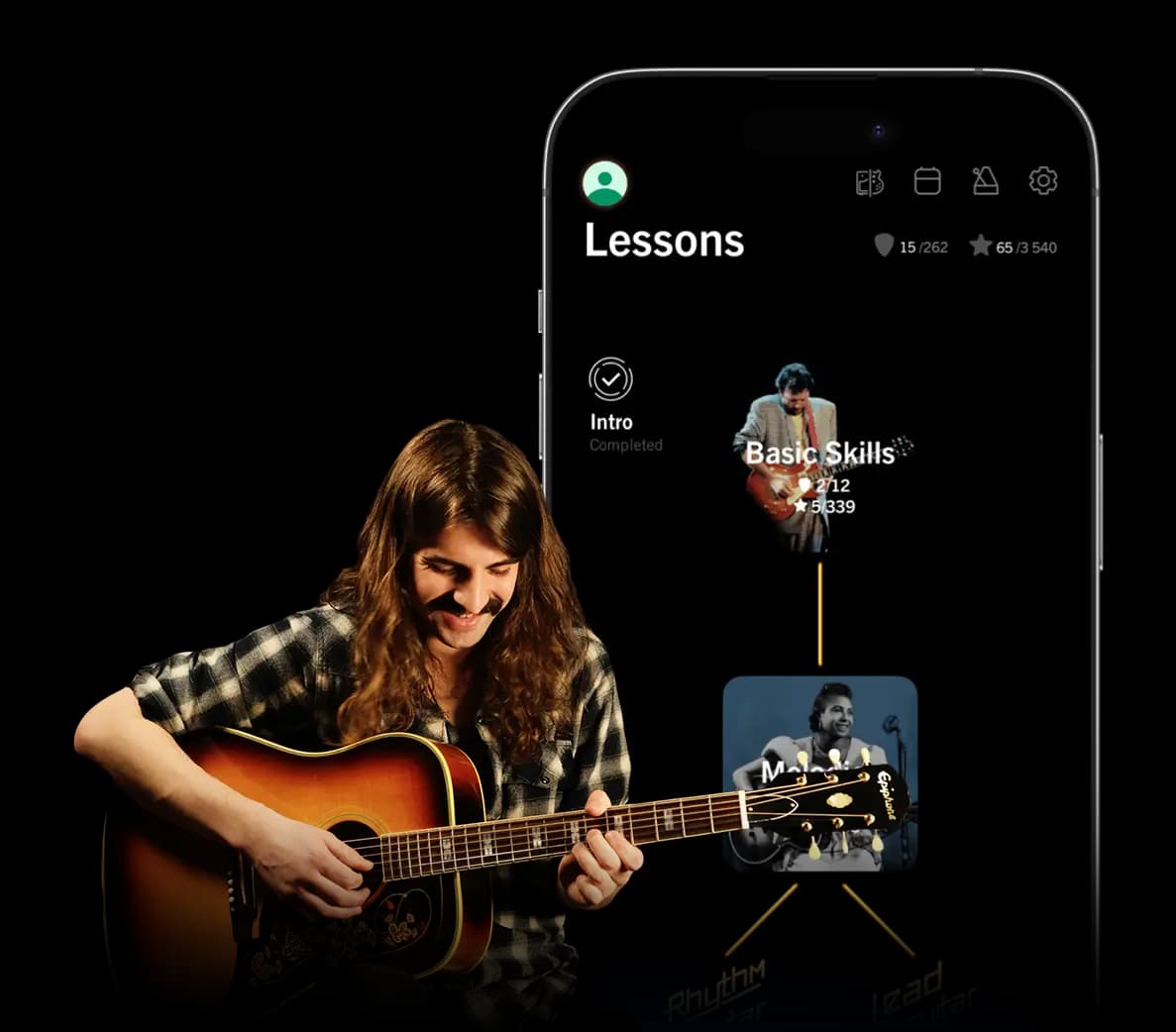
You can explore the full version of this course inside the Gibson App — along with step-by-step lessons, real-time feedback, and a personalized path designed to take your playing to the next level.
 Real-time feedback: The app listens while you play and gives instant visual and audio feedback.
- 🎮 Interactive gameplay with real song backing tracks.
- 🏆 Weekly leagues to compete and climb leaderboards.
- 🧭 Structured learning paths for step-by-step courses.
- ⚡ Deep-dive guides & genre courses to learn like the pros.
Intro to Rock
A Beginner's Guide To Playing Rock Guitar
This course is available in the Gibson App with full lessons, interactive exercises with real-time audio and video feedback.Try 7 days free
Instructor
Jamie Humphries
Jamie Humphries is a British session guitarist, educator, and author known for his extensive instructional work, live performances, and collaborations with legendary artists. He has toured with Brian May, performed with Queen, Jeff Beck, Mike Rutherford, and Henry Rollins, and was a member of The Australian Pink Floyd Show. On stage and video, he has appeared with Richie Kotzen, Vinnie Moore, Steve Morse, and Joe Satriani. Jamie has created a vast library of guitar lessons for the Gibson App and has contributed to Guitar World, Guitar Techniques, Guitarist, Total Guitar, and Premier Guitar. A former lecturer at ACM Guildford and BIMM Brighton, he also hosted his own guitar show on Sky TV.
Continue in the Gibson App
The best guitar learning app for beginner and intermediate players.
You can explore the full version of this course inside the Gibson App — along with step-by-step lessons, real-time feedback, and a personalized path designed to take your playing to the next level.
- Real-time feedback: The app listens while you play and gives instant visual and audio feedback.
- 🎮 Interactive gameplay with real song backing tracks.
- 🏆 Weekly leagues to compete and climb leaderboards.
- 🧭 Structured learning paths for step-by-step courses.
- ⚡ Deep-dive guides & genre courses to learn like the pros.
Related Articles


Michel Santunione
2025-10-23